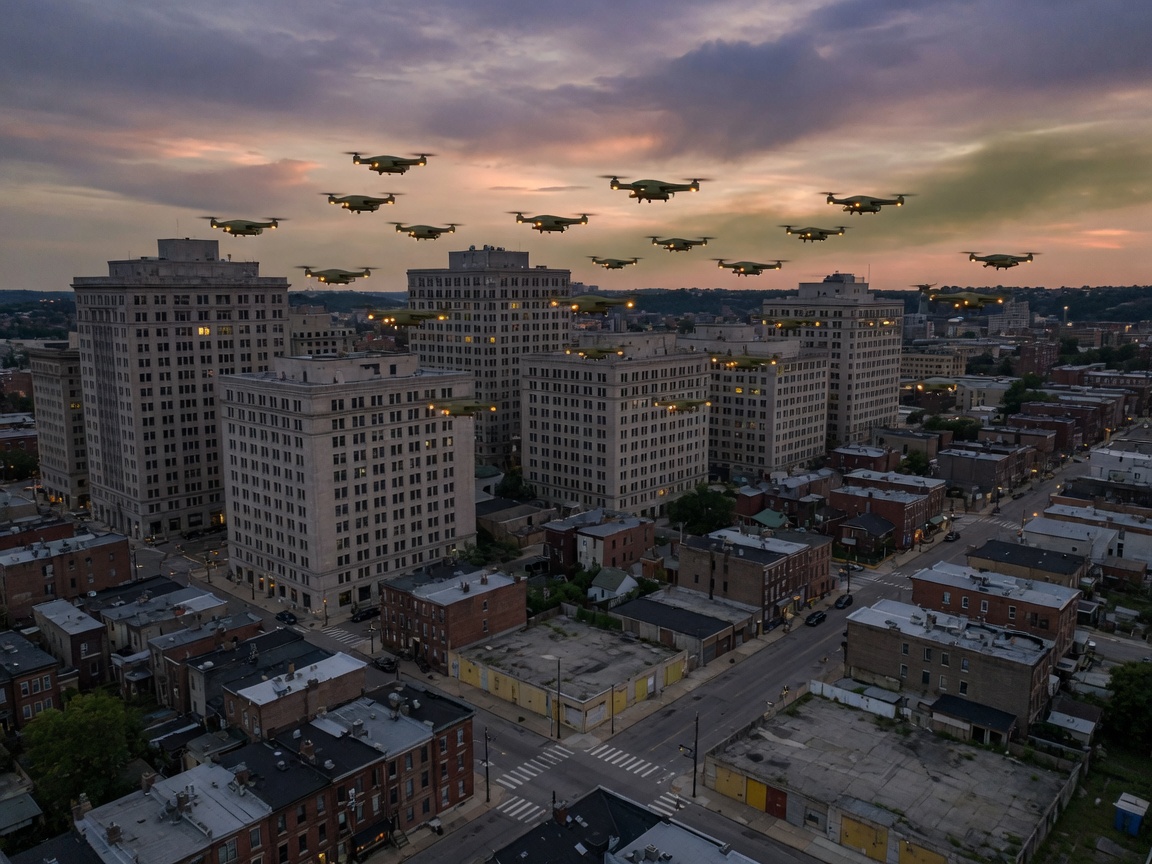
Most cities find squatters when a neighbor calls. Vacant office floors go dark, then occupy themselves. Homes sit on the ledger as empty until someone walks the block. Police work starts late and finishes later.
Keystone did not wait on a call. Mayor already kept every parcel. Mayor now programs Defender drone swarms as the patrol layer, reads the video feeds against that ledger, and actuates follow-up the same watch. Unauthorized occupancy in offices and homes became an anomaly with an owner — not a rumor with a case number three days later.
Here’s what that pairing took, capability by capability.
Purpose first, then the city is patrolled
Defender doesn’t start with a flight plan. It starts with purpose. Mayor supplies it.
For this program the north star was clear: keep the city in tip-top shape by making occupancy match the books. Vacant offices stay vacant until they are leased. Vacant homes stay vacant until they are occupied on the ledger. Squatters are occupancy anomalies, not a separate stack of paper. Purpose setup locked qualitative and quantitative outcomes, actuation guidelines, and skip logic — so parcels already holding weren’t over-touched, and every mismatch got a precise next move.
Mayor keeps the parcels; Defender flies them
The map wasn’t a GIS export in a drawer. It was the city.
Mayor’s parcel intake holds every lot, floor, and dwelling: occupied, vacant, under work, sealed. Defender does not invent that map. It flies it. Swarm routes load from the ledger; understanding-session links go to the owners Mayor already has. For this patrol, water, power, roads, public safety, and the air layer lived in one system from the first watch.
Understand the feed before you dispatch
Defender closes the intent–action gap: probe what a feed means, program the next pass, verify the parcel moved — across a city of lots at once.
Video from the swarm is not a highlight reel. Mayor reads each pass against the ledger. A vacant office with a lit floor that should be dark is an anomaly. A sealed home with heat and motion is an anomaly. Always-on city models and digital twins keep that judgment available when last-minute reroutes, extra passes, or a public-safety motion need a decision grounded in the actual block.
“The speed and quality of the 1:1s were outstanding. Defender will let my staff significantly increase the speed of delivery.”

“I would never have moderated 50 sessions in a reasonable amount of time. With Defender you can run 50 1:1s while you’re on a 20-hour flight.”

Program the swarm like a commander instruction set
Understanding alone doesn’t keep squatters out of empty towers. Programming does.
Defender turns what Mayor knows into routes, revisit times, skip logic, and playbooks — specific to each parcel. For this patrol that covered:
- Parcel ledger — every office and home, with occupancy Mayor already holds
- Drone swarms — grid routes, extra passes where the last feed disagreed, skip when a lot already held
- Video into Mayor — feeds the city can actually use, not a dump of hours
- Follow-up — who to contact, with what directive, and why, until the anomaly closed
“Defender is now the way our command team gets more, better, and faster movement out of the force — it accelerated the window substantially.”

“Leaving the interview process and the first analysis to Defender has helped me grow in the job. I spend my time actuating, not tagging.”

Actuate — and verify the block
Mayor assigns, nudges, escalates, and verifies. Defender keeps the watch until the motion closes. Missed steps escalate. Completed occupancy holds close. Management that would otherwise be impossible stays represented even when a vacant floor lights up after midnight.
Peer programs that ran the same occupancy work without Mayor and Defender kept the work in complaint: a call to staff a visit, a visit to write a notice, a notice waiting on a second visit. Keystone did not wait on paper. The product put owners in motion and watched whether the parcel actually returned to the ledger.
“Defender is an integral part of how we run the force. It changed the speed and depth of how we understand people and put them in motion.”

Resolution time is the product
Before the pairing, occupancy and parcel-related police work in Keystone sat on a median of eleven days — from first notice to a closed file. With Mayor reading Defender swarm feeds, the same class of work closed in fourteen hours. Vacant-office and vacant-home anomalies that used to wait on a beat now open a motion on the watch they appear.
That is not a faster form. It is a shorter gap between “the ledger says empty” and “the city has an owner on the lot.” All police work that starts from occupancy, trespass, and parcel condition inherited the same loop: see it, assign it, verify it.
Twin rehearsal, then fly
Before a sensitive change hits the living city — night-grid density over sealed homes, extra passes on a vacant tower, a public-safety motion off a feed — Defender can rehearse against 1:1 digital twins, with confidence scores traced back to source conversations and prior watches.
“These are tools you’d have to pry from my cold, dead hands. I truly couldn’t run the force the same way without them.”

Wherever command already works
With Defender’s MCP, operators launch programs, read the force, and chat with twins from Slack, email, Claude, Cursor, or any tool they already use. Patrol ops didn’t need a new command center. Mayor already had the parcels. Defender already had the air.
One system, two products, one city
The patrol stress-tested the same platform commands use for recruiting, training, mission motion, and change of command — now pointed at a civic ledger. Mayor understands the city. Defender actuates the swarm. Together they keep offices and homes on the books, and they keep police work from starting three days late.
Defender didn’t outsource the hard parts. It ran intake, understanding, programming, and actuation until every parcel had a watch and every anomaly had an owner.
Peer cities that were not pairing Mayor with Defender were still waiting on a call. Keystone had a patrol.